


Little Landau
The family event calendar for Landau and the Pfalz, ages 0 to 18. Collected daily from public calendars with filters and iCal feeds.
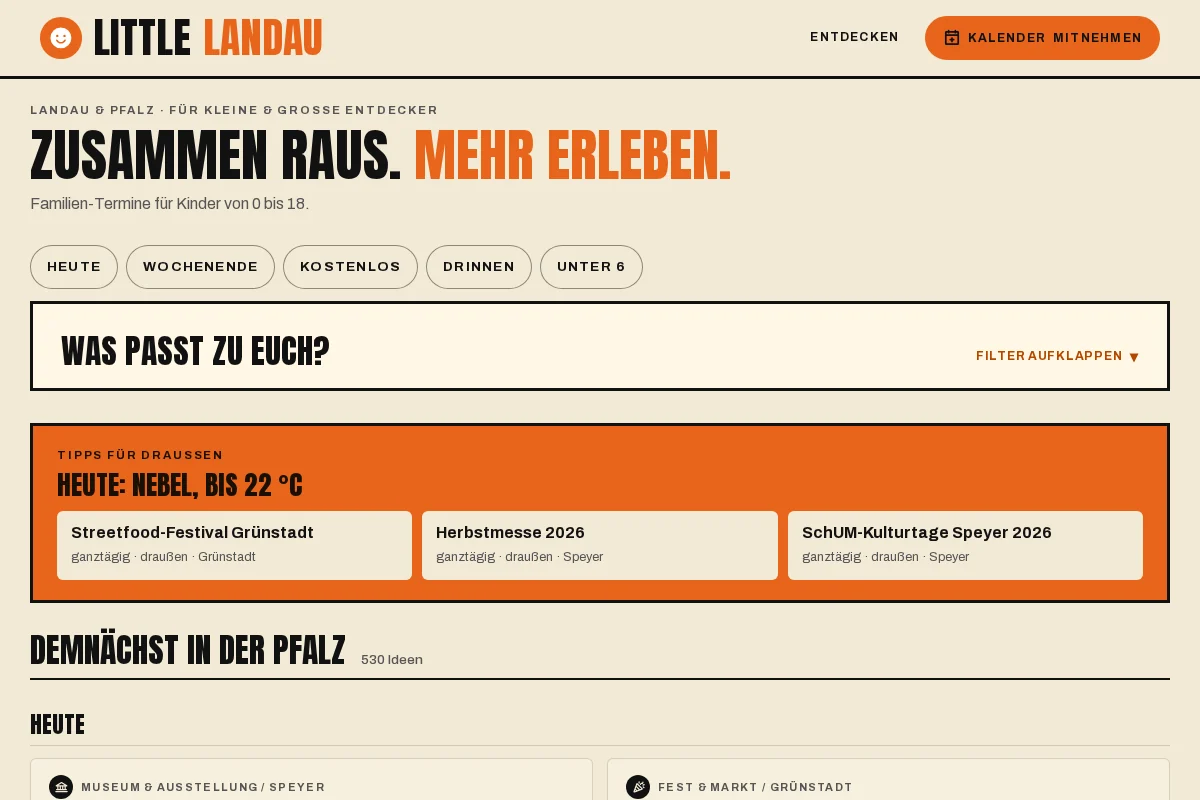
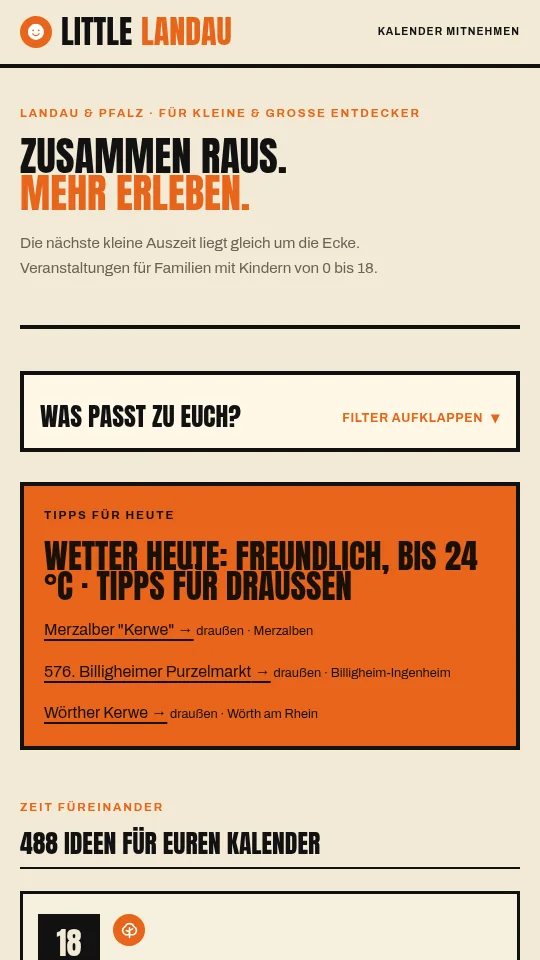
Quick filters for today, weekend, free, indoors and under 6, plus outdoor tips matched to today's weather.
Subscribe via iCal →One list of family events for the region
Family events in the Pfalz are spread over museum sites, town calendars, tourism portals and club pages. Little Landau reads them every day and shows what fits children and families in one list.
The site is in German, because its audience is. Public pages and feeds are read-only. There are no accounts and nothing to sign up for.
The main rule is that nothing is ever invented. If a source does not state the age, the price or whether an event is indoors, the calendar says it does not know.
Hundreds of events
The import takes every upcoming event from each source, with no cap.
Ages 0 to 18
Four age groups, from toddlers to teenagers.
Daily import
A worker imports new events every day and skips pages that have not changed.
Provenance
Every event names the source it came from.
What the site offers
Quick filters
Heute, Wochenende, Kostenlos, Drinnen, Unter 6. One tap each, right under the headline.
"Was passt zu euch?"
A fold-out filter for date range, distance, age group and one of ten categories, plus a text search.
Tips for today's weather
The start page looks at today's weather and suggests events that fit, outdoors when it is nice.
Take the calendar along
"Kalender mitnehmen" gives you an iCal feed of your selection. Your calendar app keeps it up to date.
Where it is
Event pages show the venue, with a map when the source gives coordinates.
Installable, offline
A PWA with an install prompt and an offline page for bad reception on the way.
A feed with your filters
The same filters the site uses are available as a public address. Choose what you want, then open the result or subscribe to it in your calendar app.
Your browser builds the address. It requests nothing until you open it.
The daily import, step by step
A worker runs once a day and goes through six steps.
A registry of reviewed sources
Museum calendars, town event feeds, a hiking club's iCal feed and regional tourism calendars. The import never falls back to a disabled source, and a source goes live only after a review of how its data may be used.
Fetching with robots.txt and caching
The crawler identifies itself honestly as LittleLandauBot and checks robots.txt first. If that check fails, the source is skipped.
The crawler revisits a known page only after a freshness period of 7 to 30 days. Conditional requests turn an unchanged page into a cheap 304 response.
Only explicit facts
The import prefers machine-readable feeds such as iCal, JSON, sitemaps and schema.org events. It quarantines an entry without an explicit date and does not guess one.
It does not invent a start time or infer an end time. Unknown age, price, location and indoor status stay unknown.
Two-stage Jev triage and family relevance
Large calendars pass a fast stage-1 triage first, checking title and URL (cached by hash so unchanged entries cost no model call; recall beats precision so uncertain entries stay in). Stage 2 then decides whether an event is relevant for children or families and fills fields the source leaves open, such as category and age group.
Facts from the source always win, and the model never overwrites them. The import records fields the model filled as estimates (shown as geschätzt). A provider error sends the entry to quarantine.
One event, listed once
At write time, alias resolution keeps renamed listings and changed source IDs attached to the same event. At read time, cross-source deduplication folds the same festival appearing across several calendars into one entry that keeps all of its sources and preserves all-day end dates.
Read-only pages and feeds
Events land in PostgreSQL. The site, the JSON API and the iCal feed all read the same selection. Only short metadata is public. Raw source documents stay private and expire after 30 days.
Rules for missing data
A wrong start time sends a family to an event that is not happening. These rules prevent that.
Nothing is invented
Not into the data and not into a deployment. Even the browser tests bring their own three-event fixture instead of placeholder content.
Unknown stays unknown
A filter for "free" matches only events known to be free. Events with an unknown price match neither "free" nor "not free".
Failures stop the import
A source that cannot be read ends up in quarantine and makes the import exit with an error. It never silently turns into an empty or partial result.
Every event has provenance
Each entry carries its sources, the time it was fetched and a content hash.
Read-only public API, no key needed
| Endpoint | Returns |
|---|---|
GET /api/events | JSON events with their matching occurrences and provenance. Supports page and limit from 1 to 100. |
GET /api/calendar.ics | The same selection as an iCal feed, unpaginated, with stable occurrence UIDs. |
GET /event/:id | The detail page of one event. Missing IDs return 404. |
Filters
| Parameter | Meaning |
|---|---|
q | Text search |
from, to | Inclusive calendar dates in the Berlin time zone |
region | Town |
ageGroup | kleinkinder for ages 0 to 1, vorschulkinder for 2 to 5, schulkinder for 6 to 11, jugendliche for 12 to 18 |
category | natur, kreativ, musik, theater, sport, museum, fest, vorlesen, workshop, kirche, sonstiges |
free, indoor, highlight | true or false. Unknown facts match neither value. |
id | One event |
curl "https://little-landau.de/api/events?free=true&ageGroup=vorschulkinder&limit=5"
Invalid filters return 400. Responses carry content-based ETags, so a repeated request can be answered with 304.
The feed uses date-only values where a time is unknown, Berlin time zone rules and an explicit cancellation status. Unknown end times are left out.
Two apps, five packages
A monorepo with a web app and a worker. The web app renders pages and feeds. The worker runs the daily import.
- Web: Next.js and React, with a service worker for offline use.
- Data: PostgreSQL through Prisma, with checked-in migrations.
- Worker: a crawler package, a source registry and shared contracts validated with zod.
- Tests: unit tests and Playwright browser checks against a seeded fixture.
- Deploy: Docker, with a deploy script that takes a git commit and can roll back.
The source code is not public.
public calendars
      │  daily, robots-checked, cached
      ▼
   worker ── extract ── classify ── dedupe
      │
      ▼
  PostgreSQL
      │
      ├─► little-landau.de   pages
      ├─► /api/events        JSON
      └─► /api/calendar.ics  iCal